
Gallatin Projected Versus Actual Release
A projected date is a current calculation. An actual release date records an event. Final discharge marks the later end of the sentence or supervision duty. Those dates can differ. Illinois’s public IDOC field is labeled “Projected Discharge Date,” not “Projected Release Date.” Read that exact label with Offender Status, Location, Parole Date, and “Sentence Discharged?”
A person can have PAROLE status and a future Projected Discharge Date. That means the person left prison for supervision before the sentence ended. By contrast, IN CUSTODY means the person remains in IDOC custody. For a Gallatin detainee at Saline, the jail’s release entry supplies the physical exit or transfer time.
Pretrial custody works differently. Without a sentence, there is no sentence-based release calculation. A court order, case outcome, and other holds control, while Saline confirms when physical processing occurred.
Find Gallatin Projected Release Dates
Start with the custody source. Gallatin County has no operating jail. Saline County Detention Center houses Gallatin detainees by contract, while IDOC controls a later state-prison commitment.
- Determine whether the person is pretrial, serving a Saline jail sentence, committed to IDOC, or held by a federal authority.
- For IDOC, open the offender search and search by last name, IDOC number, or birthdate.
- Match date of birth, IDOC number, sentencing county, offense, and custody date before relying on the record.
- Read status, location, Parole Date, Projected Discharge Date, and each sentence row together.
- For a Saline sentence, ask the detention center and Gallatin sentencing court for the sentence, custody credit, calculation, and actual release entry.
- Request written IDOC confirmation when the public record is unclear or a formal record is needed.
The IDOC search is not a county-jail release list. A person released from Saline without an IDOC commitment may have no relevant IDOC event. The Gallatin County release-record path explains how Gallatin arrest records, Saline custody, and the court docket fit together.
The official IDOC search entry page leads to the state lookup shown below.
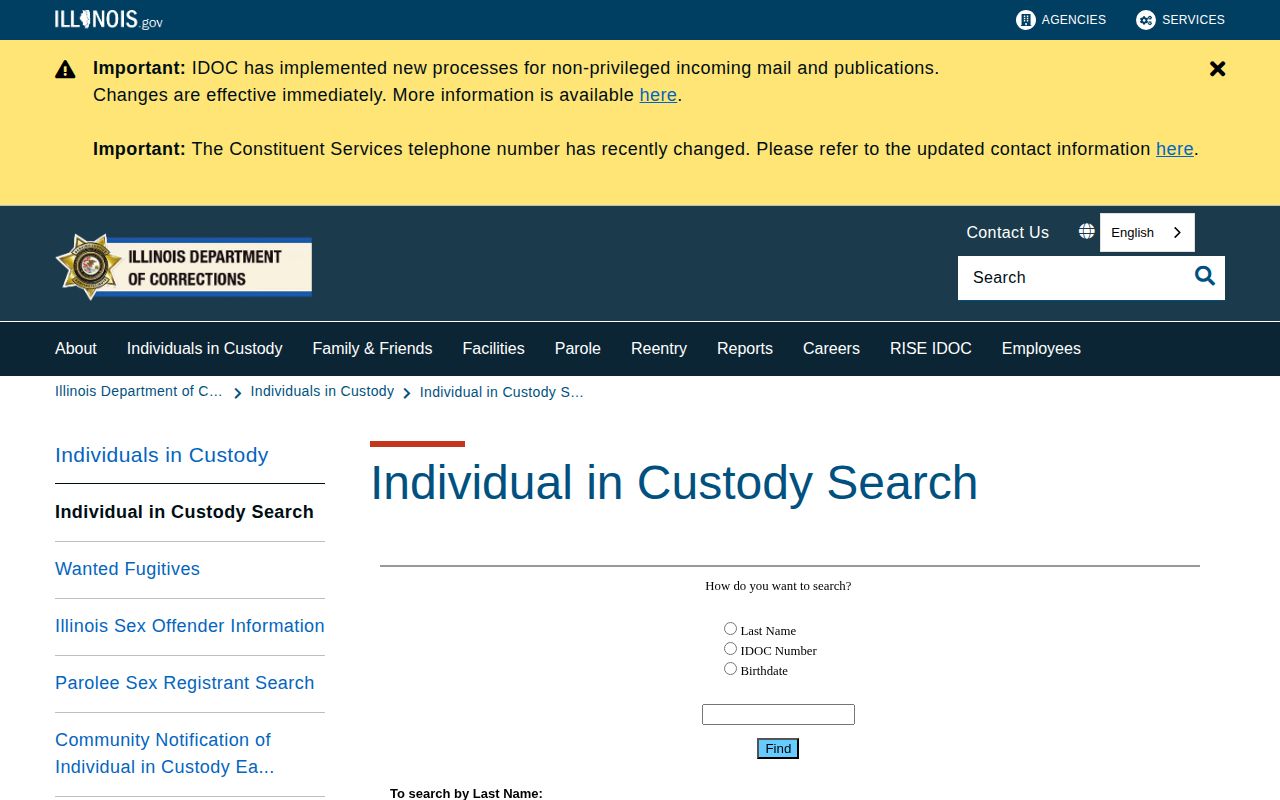
Use the state screen only for an IDOC commitment, then open the matching profile to find the exact discharge and parole fields.
Gallatin Sentence Credit Rules
Illinois sentence credit is governed principally by 730 ILCS 5/3-6-3. The statute has several regimes. Eligible sentences may use a broader credit framework, while offense type, offense date, bodily-harm findings, exclusions, discipline, and program credits can alter the calculation. No single percentage applies to every person.
Specified truth-in-sentencing offenses limit credit to 4.5 days per month, often summarized as about 85 percent served. First-degree murder and other listed cases may receive no sentence credit. Other cases can have different credit. Do not hand-calculate a date from the sentence length alone.
IDOC Records Office calculates determinate-sentence release dates. The PRB mandatory supervised release explanation states that the Board generally lacks discretion to release a determinate-sentence prisoner before IDOC’s calculated date. The offense-specific statute and official calculation control.
Note: The familiar “serve half” and “serve 85 percent” phrases are both unsafe unless the actual offense and sentence-credit rule support them.
Why Gallatin Release Dates Change
A displayed projection reflects information then in the system. New legal or administrative events can move it. The issuing agency should resolve a conflict rather than an outside estimate.
| Factor | Possible effect |
|---|---|
| Credit award or recalculation | May change the computed date under the governing rule |
| Disciplinary credit loss | Can extend the current projection |
| Sentence or court change | May alter the term or custody basis |
| New case, warrant, or hold | May prevent community release even after one custody ends |
| Administrative correction | Can revise data used in the display |
| Parole or MSR status | May mark prison release while final discharge remains later |
A detainer is a request or notice that another authority wants custody. Transfer under a detainer is not release to the community. The Saline booking record should name the receiving authority when a Gallatin detainee leaves by transfer.
Confirm Gallatin Release Events
For Saline custody, call 618-252-8661 and ask whether the person was released or transferred. If staff cannot confirm by phone, request the booking/release entry and its date, disposition, releasing authority, and destination. A Gallatin court order supplies legal authority but may precede the actual jail processing time.
For IDOC custody, compare the public record and request written confirmation from the IDOC Public Information Office at 1301 Concordia Court, P.O. Box 19277, Springfield, Illinois 62794-9277, or call 217-558-2200. Specify the IDOC number and the status, parole, projected discharge, or sentence-discharge field needed.
The Gallatin VINELink check can provide a prospective alert when a participating agency reports a change. Treat the alert as corroboration and confirm with the named custodian. BOP, ICE, and USMS matters require their own systems; none is replaced by an Illinois VINELink result.
Gallatin IDOC Date Fields
The IDOC profile must be read as a set. Admission Date concerns entry into the state system. Parole Date and Last Paroled Date concern release from an institution to supervision. Projected Discharge Date forecasts the end of the state sentence or supervision, subject to change. A sentence row may also state “Sentence Discharged?: NO.” That answer can coexist with PAROLE status.
| IDOC field | Meaning for release |
|---|---|
| Offender Status | Shows whether IDOC reports parole, in custody, or another current status |
| Location | May name an institution or a parole district |
| Parole Date | Supports the prison-to-supervision event |
| Projected Discharge Date | Forecasts the computed sentence or supervision endpoint |
| Sentence Discharged? | Shows whether that sentence row is recorded as complete |
“INELIGIBLE” can appear in the projected discharge field in a life-sentence context. It should not be converted into a guessed date. Sentence rows can also show mittimus, offense, sentence, county, custody date, and discharge status. A mittimus is the court document directing custody after sentencing. Use those details to confirm that the profile belongs to the right Gallatin case.
IDOC data can change quickly. A screenshot documents what the public interface showed at one time, not a permanent promise. Save the search date and request written confirmation for a formal need.
Gallatin Release Date Custody Lanes
A county sentence held at Saline should not be computed from the IDOC screen. Ask Saline for the custody date, credited time, jail-sentence calculation, other holds, and actual release entry. Ask the Gallatin sentencing court for the filed sentence and any later order. The two records answer related but different questions: the court defines legal authority, while the holding jail documents physical processing.
A pretrial detainee has no fixed sentence endpoint. An order may permit release, yet another warrant or hold may keep the person in custody. The Office of Statewide Pretrial Services can address pretrial supervision within its role, but it is not the Saline release-record custodian and is not a payment counter. Confirm the physical event with Saline.
Federal custody creates another lane. The BOP Inmate Locator can show a Release Date for people in its coverage, which begins in 1982, but recalculation can change dates. “Released” or “Not in BOP Custody” means only that BOP custody ended. USMS pretrial or transport custody can occur before BOP designation, and no nationwide public USMS historical release database was found. ICE’s locator is current-custody oriented and cannot reconstruct every past release.
Chronology helps test the record. A Saline transfer should normally precede state or federal admission, though administrative dates may differ. A parole date should not be called final discharge when the projected discharge is later. When systems disagree, preserve each exact field and ask the issuing agencies to reconcile their own data.
Keep a simple search log. Record the date and time, the exact system, jurisdiction, name spelling, identifiers, and result. For a common name, note why the profile matches without collecting needless personal detail. Partial last-name searches in IDOC can find spelling variants, but they also broaden the match pool. Narrow the result with the IDOC number, birthdate, sentencing county, offense, and custody date.
A no-result is not a release date. IDOC does not cover a Gallatin county-jail release that never became a state commitment. BOP has a stated coverage start. ICE focuses on current detention, and VINELink depends on source participation. Follow the known custody trail and ask the responsible record office when a public tool cannot answer.
Written requests work best when they name existing fields. For IDOC, give the IDOC number and request status on a stated date, institution release or parole date, projected or actual discharge, and sentence-discharge information. For Saline, request the booking number, intake time, release or transfer time, disposition, releasing authority, and receiving destination. For the clerk, request the filed sentencing, release, or disposition order by case number.
Those records should not be merged into one invented date. A court order can precede jail processing. A county transfer can precede state admission. A prison release to parole can precede final discharge by months or years. Keeping each event label intact gives a more accurate Gallatin County timeline.
Recheck a projection near the expected event. Sentence credits, discipline, a court change, or a newly recorded hold can alter the result after an earlier search. Do not state that the person “gets out” on the displayed date unless the responsible custodian confirms the physical release. If the public field changes, save both observation dates and use the newer official record while noting that the earlier projection was superseded. For a person already on parole, focus on the Parole Date for prison departure and the Projected Discharge Date for the later sentence endpoint. Those are distinct questions and should remain distinct in any written chronology.
When the date matters for travel or family coordination, confirm it directly before making firm arrangements because a forecast can change.