
IDOC Release Paths
A Gallatin prosecution can result in commitment to IDOC even though no state prison is located in Gallatin County. IDOC assigns the person within its statewide system. Release from an institution can lead to parole or mandatory supervised release, often called MSR. Both are supervised statuses. Final discharge is the later end of the sentence or supervision obligation in that system.
An IDOC person record may show an institution while the person is in custody or a parole district after prison release. A status of PAROLE and a Parole Date support release from prison into supervision. They do not prove final discharge. A transfer out of Saline County Detention Center to IDOC is also not a community release; it begins the state-custody phase.
Confirm an IDOC Release
Open the official IDOC inmate-search wrapper and enter the legacy application. Search by Last Name, IDOC Number, or Birthdate. The name field accepts a full, last-only, or partial last name. Select a plausible record only after comparing identifiers. Then inspect Offender Status, Location, Admission/Release/Discharge Information, and the sentencing rows.
- Search by the strongest known identifier.
- Match date of birth and IDOC number.
- Confirm sentencing county, offense, and custody date.
- Read Parole Date and Projected Discharge Date separately.
- Check whether each sentence says discharged.
A future projected discharge does not necessarily mean the person remains inside a prison. The balance may run under parole or MSR. The Gallatin County release record guide explains the earlier county and court steps that IDOC does not replace.
IDOC Release Record Contact
IDOC warns that public data can change quickly. For written confirmation, the research identifies its Public Information Office at 1301 Concordia Court, P.O. Box 19277, Springfield, Illinois 62794-9277. The public information telephone is 217-558-2200. A separate 1-888 line is identified for government and law-enforcement users and should not be treated as the ordinary public help number.
Provide the IDOC number when known. Specify the exact event or fields needed, such as institution release or parole date, status on a given date, actual or projected discharge, and sentence-discharge information. Cite the public result only to help locate the file. Ask IDOC which existing record can be certified and what current identity, access, or exemption rules apply.
IDOC Record Fields
The observed IDOC profile includes a photo, IDOC number, name, Parent Institution, Offender Status, Location, physical descriptors, marks, scars, and tattoos. Its Admission/Release/Discharge panel can include Admission Date, Parole Date or Last Paroled Date, and Projected Discharge Date. Sentencing rows can show mittimus, class, count, offense, custody date, sentence, county, and “Sentence Discharged?: YES/NO.”
| Field | Meaning |
|---|---|
| Offender Status | Current IDOC status shown |
| Location | Institution or parole district |
| Parole Date | Release from prison to supervision |
| Projected Discharge Date | Computed expected end of the state obligation |
| Sentence Discharged | Whether a listed sentence has ended |
“IN CUSTODY” means the person remains in IDOC custody. “INELIGIBLE” may appear in the projected discharge field in a life-sentence context. Explain the displayed record rather than reducing it to one date.
IDOC Projected Discharge Meaning
Illinois uses the exact public label “Projected Discharge Date.” It is not a guaranteed prison gate appointment. Sentence credit, lost credit, court action, parole decisions, and other case-specific events can change calculations. Illinois law contains different credit rules. Some specified offenses limit credit to roughly 85 percent served, some categories receive no credit, and other cases use different rules. No one rate applies to all IDOC prisoners.
Release from prison can occur before final discharge. A PAROLE status, parole district, and Parole Date may coexist with “Sentence Discharged?: NO” and a later projected discharge date. That combination means institutional custody ended while state supervision continued. Final discharge should be confirmed through the IDOC record and, where applicable, the Illinois Prisoner Review Board.
IDOC Search Interface
The official IDOC search wrapper is the stable entry point for the statewide application.
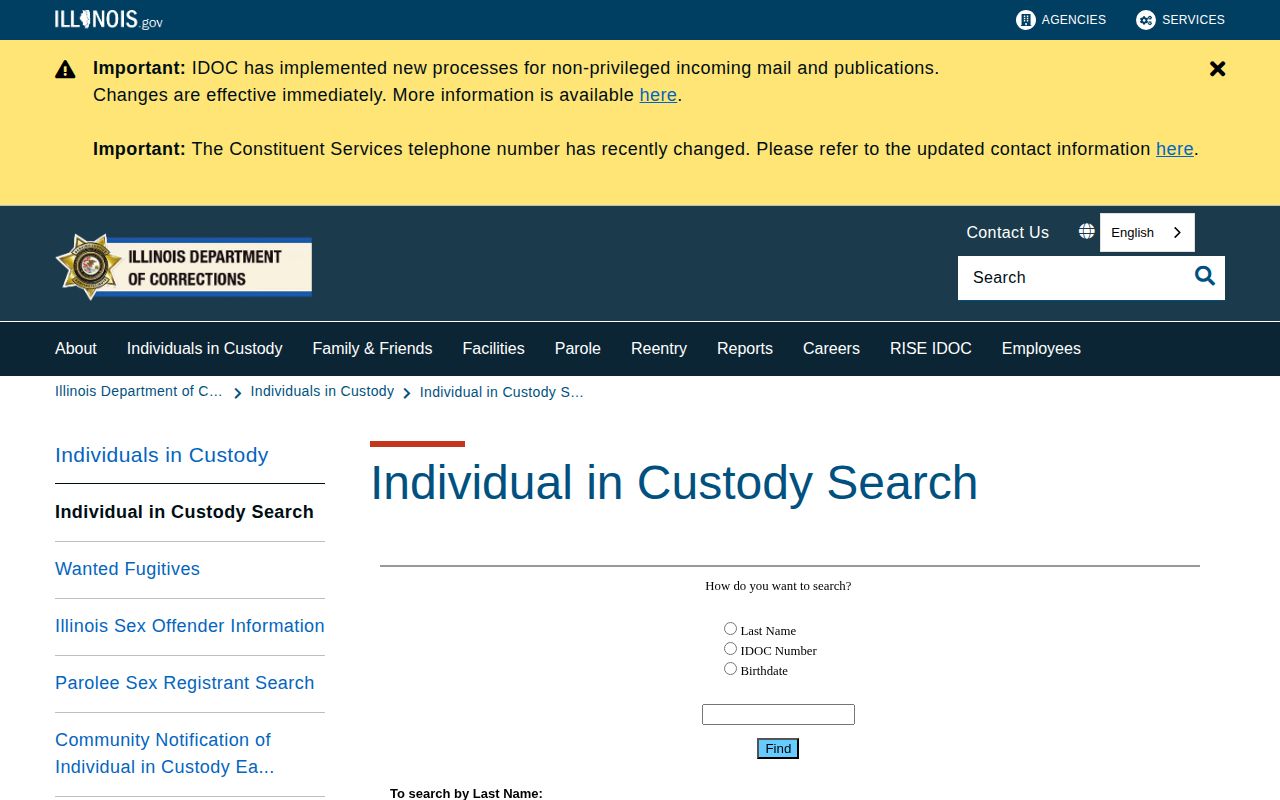
The embedded application is dynamic. Save the stable entry URL and note the search date, fields used, and exact status. Fully discharged historical discoverability was not established as universal. A no-result can reflect spelling, coverage, sealing, or system limits and does not prove the person was never in IDOC custody.
IDOC and Gallatin Custody
Keep the county and state events separate. Gallatin Sheriff records show arrest and transport. Saline records show physical county-jail intake and exit when it held the detainee. Gallatin court records show the commitment order. IDOC shows state admission, placement, prison release, parole status, and discharge-related fields. The dates may differ because each agency records its own event.
If a federal detainer or another county appears, IDOC departure resolves only state custody. Continue with the named authority. Likewise, a person bonded from Saline without an IDOC commitment may never have that county release in this database. IDOC is not a statewide county-jail release list and should never be presented as one.
IDOC Identity and Chronology
Common names require more than a name match. Compare birthdate, IDOC number, sentencing county, offense, custody date, physical profile, and event order. Search spelling variants, suffixes, and prior surnames when appropriate. A partial-name result can locate candidates, but narrow it before attributing a status. Log the search date, exact system, fields used, and result.
Chronology catches errors. A Saline transfer should normally precede IDOC admission, though transport and data entry can produce different dates. A Parole Date is not final discharge when projected discharge remains later. A Gallatin order may precede jail processing. Preserve conflicts and ask each issuing agency about its own field.
The Illinois Prisoner Review Board handles designated release, condition, revocation, and final-discharge decisions, but no single public person-by-person decision database was found. Schedules, result documents, registries, and minutes serve different functions. IDOC remains the main public person-record route. Its wanted-fugitives page is limited, not a complete list of every supervision problem. For precise status, use the IDOC record and direct confirmation from the responsible state authority.
Written agency confirmation is the best next step when a public state result remains unclear, incomplete, or historically limited.